
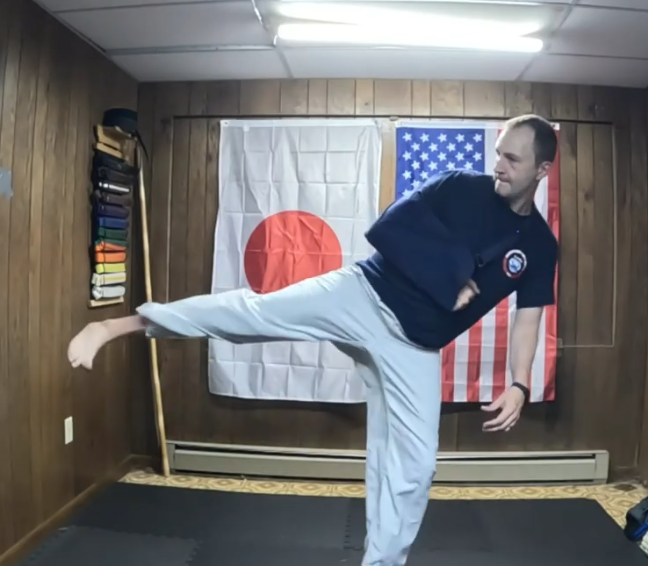
Karate With Injuries or Disabilities: How to Keep Training Safely
One of the most common misconceptions about martial arts is that you have to be in peak physical condition to step onto the mat. At the Online Shotokan Karate Academy, the number one question we get from prospective students is: “I have an injury or a disability can I still do Shotokan?”
The answer is a definitive yes.
Shotokan Karate is a lifelong journey of self-improvement, not a rigid mold that every body must fit into. Whether you are recovering from a recent surgery, dealing with a chronic condition, or living with a permanent disability, your training does not have to stop. You just need to learn how to adapt.
Shifting Focus: Training What is Healthy
When a physical limitation strikes, the biggest mistake students make is focusing entirely on what they can’t do. If you can’t punch, you might think you can’t do Karate. But Shotokan offers so much more than just upper-body strikes.
If an injury puts one part of your body out of commission, use that time to master another.
- Upper-Body Injury? Focus on Stances: If you have a torn bicep or a shoulder injury, pull your guard in close and focus entirely on your lower body. Use your training sessions to perfect your zenkutsu-dachi (front stance) or kokutsu-dachi (back stance). Work on smooth transitions and maintaining a level head height without bobbing.
- Lower-Body Injury? Focus on Upper-Body Dynamics: If a knee or ankle issue limits your mobility, sit or stand stably and dedicate your energy to fast, crisp hand techniques, hip rotation, and upper-body blocking forms.
Practical Ways to Modify Your Shotokan Drills
Training through an Online Shotokan Karate school offers a unique advantage: you are in the comfort of your own home, meaning you can easily use household items to create a safe, adaptive training environment.
1. The Chair Method for Balance Support
For students dealing with nerve damage, vertigo, or lower-body weakness, balancing on one leg for kicks like mae-geri (front kick) or yoko-geri (side kick) can feel impossible.
The Fix: Place a heavy, stable chair next to you. Hold onto the backrest for support while executing your kicks. This allows you to build hip strength and correct chambering technique without the risk of falling.
2. Modifying Stances for Joint Replacements
Hip and knee replacements are incredibly common among seasoned Karateka. If deep stances or sharp hip rotations cause pain, do not force them.
The Fix: Shorten your stances. A higher, narrower stance relieves immense pressure on the hips and knees while still allowing you to practice the foundational mechanics of the art.
3. One-Handed Combinations
If you cannot pull your hand back into a tight hikite (chamber position) due to an arm or wrist injury, don’t stop practicing your kata or combinations.
The Fix: Keep the injured arm tucked safely against your body to protect it, and execute your blocks and strikes entirely with the healthy side.
Work with Your Online Shotokan Instructors
We are karate coaches, not medical doctors, so you should always listen to your physician or physical therapist first. However, we are fully committed to helping you find creative, safe solutions to keep you moving.
If you are training in our online academy and preparing for an upcoming belt test, just give us a gentle heads-up about your physical limitations. We are always happy to modify testing requirements so that you are judged on your effort, technique, and personal progress—not your injuries.
Don’t let a physical setback put an end to your martial arts goals. Listen to your body, make the necessary modifications, and keep pushing forward on the path of Shotokan.